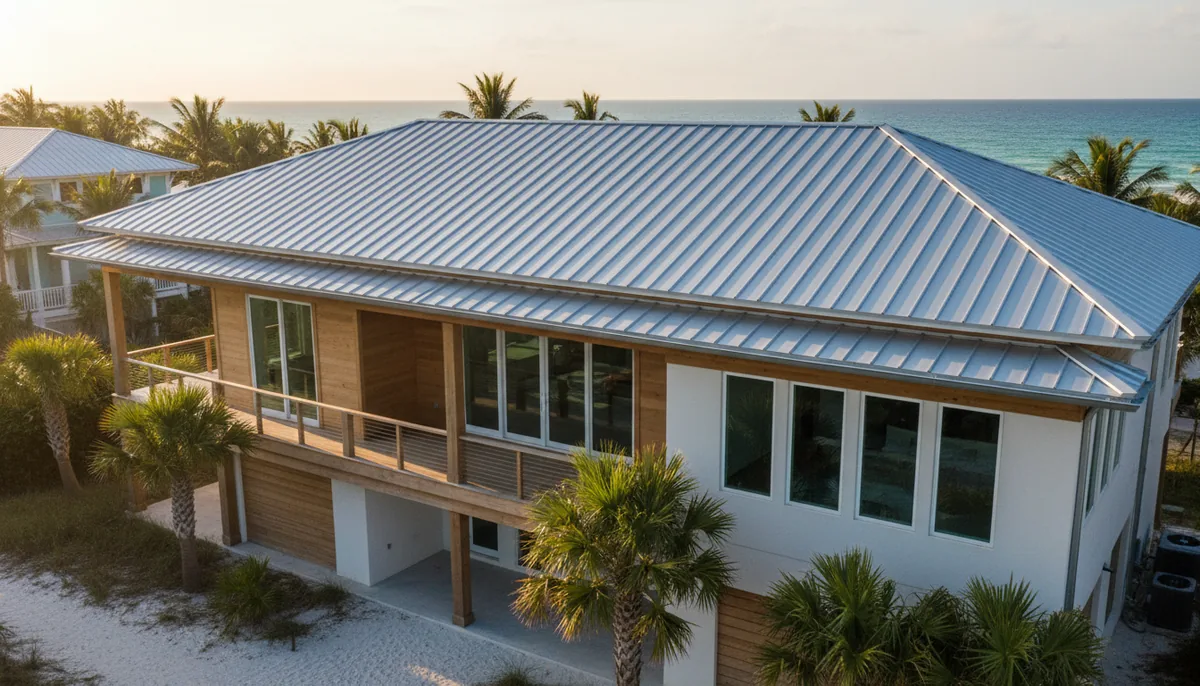
Florida approved metal roofing: The Florida Guide
By Dale Prescott, Roofing contractor, Central Florida. Reviewed by Hal Winstead, Editor, licensed roofing contractor.
Late one August afternoon I was on a barrel tile roof in DeLand, pulling off split tile that had been patched one time too many. A neighbor walked up with a metal sample in his hand and asked if it was “Florida approved metal roofing.” I tossed a piece of tile into the pile, wiped my neck, and pointed him to metal roofing companies in Florida. The sales pitch had convinced him, but the product approval hadn’t.
Here’s what gets lost in search ads: “Florida approved” isn’t a seal on a box. It’s a proccess with a paperwork trail. The panel has to meet the wind and impact requirements for your part of Florida. The fasteners have to match the manufacturer’s spec. The flashing has to work with your roof’s details. And the installer has to pull a permit and stand behind the work when the inspector pokes at it. Miss any one of those and you don’t have a Florida approved metal roofing system. You have a very expensive roof over a shed.
I’m not trying to scare you. I’m trying to get you to a better ending. The last thing I want to do is tear off a metal roof that’s only three years old because somebody trusted a salesman more than the building official.
What does “Florida approved” metal roofing actually mean?
Read any forum and you’ll see somebody asking which brand carries the label. The label you’re picturing doesn’t exist. What exists is a metal roofing system that meets the Florida Building Code on paper and, after installation, actually looks like it does on paper. The local building official makes the final call.
I’ve seen a beautifull panel fail because the crew used a different screw from the manufacturer’s spec. That roof wasn’t Florida approved at the end, no matter what the brochure said. Call it a system, not a single material. The panel matters, but so do the deck prep, underlayment, clips, trim, and the guy running the screw gun on a hot afternoon.
The good part is that metal can be an excellent roof in Florida. The honest part is that “approved” is earned, not bought.
Who can put the roof on? Start with the licence number
Florida roofing contractors are licensed by the Department of Business and Professional Regulation. Any roofer who gives you a bid should be able to show you a licence. Look for the DBPR licence prefixes CCC and RC. A CCC licence is certified and good anywhere in the state. An RC licence is registered and only valid in the local jurisdiction that issued it. Both can be completely legitimate, but the difference matters when your house sits outside the county where the RC contractor is registered.
The importent part is that the number is active and in the name of the company you’re hiring. I’d rather work with a registered roofer down the street than a certified name that subbed the whole job out twice. Nobody in this business should mind you checking. If they get huffy, that tells you something.
What I would actually do: Before I signed anything, I’d check the licence number on the side of the truck against the DBPR roll. Active and matching beats a fancy estimate.
Permits are part of the deal, not a suggestion
A roof replacement in Florida means a permit from the local building department and an inspection. A contractor who suggests skipping it isn’t doing you a favor. He’s protecting himself. An unpermitted roof can complicate an insurance claim and make a future sale miserable. I don’t know how every insurer treats permit history, but I’ve never heard a homeowner say, “Glad we didn’t pull that permit.”
For what it’s worth, I understand the temptation to rush. Ask anyone who has re-roofed in July about the 3:30 thunderstorm. You watch the radar, you push the crew, and you pray nobody gets caught on a wet metal slope. The permit process feels like a delay. It isn’t. It’s a second set of eyes that keeps you honest.
What I would actually do: If a roofer tells you the town doesn’t require a permit, call the building department yourself. Two minutes beats a future insurance headache.
The 25% rule changed. Know which rule applies to your roof.
People still repeat the old line: if the roofer has to fix more than a quarter of the roof, you have to replace the whole thing. That came from the Florida Building Code, and it was true for a long time. Then came SB 4-D (2022), and the math changed.
Here’s the simple version. If your roof was built, repaired or replaced under the 2007 Florida Building Code or any later edition, only the portion being worked on has to meet current code. That means a roofer can often repair one bad slope without dragging the whole roof into a replacement. If the roof is older, finished before the 2007 edition took effect on March 1, 2009, the old rule can still bite.
I’m not a lawyer and I don’t make the final interpretation. The building department does. But when a homeowner tells me the insurance adjuster already “knows the rule,” I tell them to get it in writing from the county before we start.
Wind mitigation inspections: the discount that can pay for itself
Most metal roof customers don’t know about wind mitigation inspections, and that’s a shame. The inspection documents roof covering, roof deck attachment, roof-to-wall connection, roof geometry, secondary water resistance, and opening protection. Florida insurers must offer premium discounts for qualifying features. The standard document is form OIR-B1-1802.
That inspection usually costs less than the annual discount it can earn. I’ve seen it pay for itself in one year. But the discount is about the whole roof assembly, not just the metal panels. I can install a good metal roof and still have a weak roof deck attachment field because the framing was never tied down right. The panel doesn’t fix that.
What I would actually do: Have the wind mitigation inspection done after the metal roof is installed, before you call your insurer. The panel doesn’t win the discount—the form does.
Questions I get asked
Does a metal roof make my insurance cheaper?
It can, because Florida insurers must offer premium discounts for qualifying features on the wind mitigation form. But that depends on your policy and the actual construction of your roof. I’m not an adjuster and I don’t know what your policy covers. Read the declarations page and ask your agent directly.
Will a metal roof survive a hurricane?
Properly installed, a metal roof gives you a fighting chance, but no roof is hurricane-proof. The screws, clips, and flashings matter more than the brand. I’ve seen a metal roof with the right panels lose fasteners because the crew used the wrong screws. It’s the details that keep it down.
If my roofer repairs only one bad section, can he leave the rest alone?
Yes, if your roof was built, repaired or replaced under the 2007 Florida Building Code or any later edition. SB 4-D (2022) means only the section being worked on has to meet current code. Older roofs can still fall under the old rule.
How much should I budget for a metal roof?
I can’t give you an honest number without seeing the roof. Metal roofing is priced per square, and the price changes with pitch, access, and what’s under the old covering. Get three itemized bids and compare the details, not just the bottom line.
What counts as “Florida approved metal roofing”?
No single brand owns that phrase. It means a metal roofing system matches it's tested and approved design, gets installed to code, and passes the local inspection. That